Le Barthélemy: How Grand Cul-de-Sac's Lagoon Hotel Redefined Caribbean Ultra-Luxury Hospitality
April 2, 2026 · 15 min read
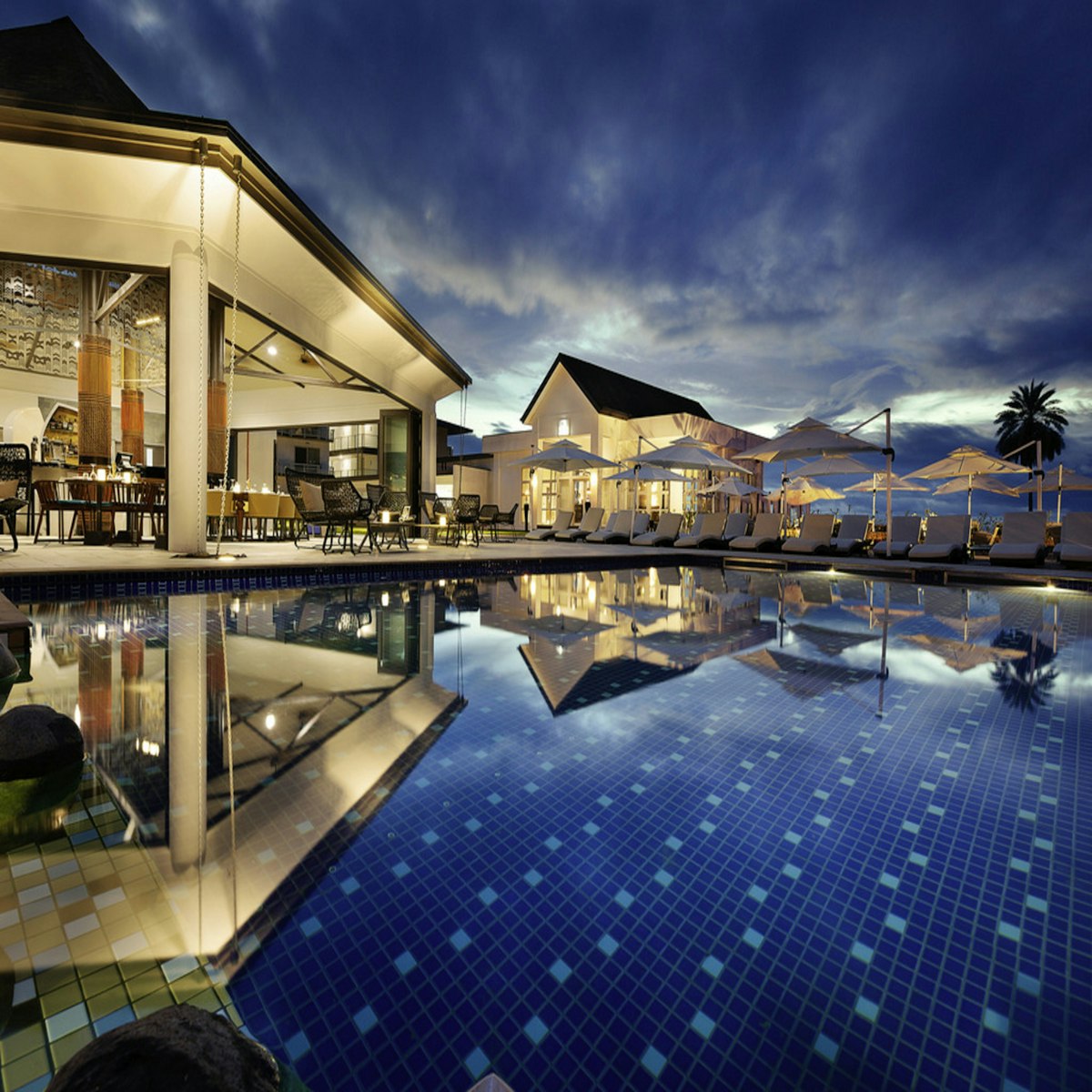
On an island where luxury hotels compete with the intensity of art houses at Cannes — each vying for the designation of "most exclusive," "most intimate," "most Saint Barth" — Le Barthélemy Hotel & Spa occupies a position of architectural and experiential clarity that its competitors struggle to match. Situated on the northern shore of Grand Cul-de-Sac, where a shallow turquoise lagoon is protected from the Atlantic swell by a coral reef that breaks the waves into white noise, Le Barthélemy has accomplished something that remains genuinely rare in Caribbean hospitality: it has created a hotel that feels inevitable in its setting, as though the lagoon had been waiting for precisely this building, and the building had been designed for no other lagoon.
The Lagoon Advantage
Grand Cul-de-Sac is not Saint Barth's most famous beach — that distinction belongs to Saint-Jean, with its hair-raising aircraft approaches, or to Gouverneur, with its clothing-optional discretion. But Grand Cul-de-Sac possesses something that no other beach on the island can offer: a lagoon. The coral reef that extends across the bay's mouth creates a body of water that is simultaneously ocean and swimming pool — shallow enough to wade across in places, warm enough to swim year-round, and so consistently calm that the surface often achieves a mirror-like flatness that makes the horizon line between water and sky genuinely ambiguous.
This hydrological peculiarity has made Grand Cul-de-Sac the centre of Saint Barth's water sports culture. The consistent trade winds that funnel through the gap between Tortue Island and the mainland create ideal conditions for kitesurfing, and on any given afternoon the lagoon's surface is populated by dozens of kites in colours that seem chosen to complement the water beneath them. The lagoon is also home to one of the island's healthiest marine ecosystems: sea turtles graze on the seagrass beds, juvenile reef fish shelter in the coral shallows, and spotted eagle rays patrol the deeper channels with a languor that suggests they know exactly how photogenic they are.
Architecture as Understatement
Le Barthélemy was designed by Sybille de Margerie — the Parisian architect whose portfolio spans the Four Seasons George V renovation to the Peninsula Paris — and the building reflects her characteristic philosophy that luxury architecture should amplify rather than compete with its setting. The hotel's forty-four rooms and suites are arranged in a low-rise configuration that follows the beach's gentle curve, never exceeding two storeys, their whitewashed facades and natural-stone accents reading as a contemporary interpretation of the Antillean plantation vernacular rather than the generic tropical-modern aesthetic that has colonised Caribbean resort architecture.
The interiors — by the Parisian firm Chzon — deploy a palette of warm whites, bleached woods, and tactile linen that achieves something subtler than the typical "barefoot luxury" formula. There is rigour here: the furniture is predominantly custom, the lighting is considered with the attention of a gallery installation, and the spatial planning prioritises sight lines to the lagoon with an almost obsessive consistency. Every suite is oriented so that the first thing a guest sees upon waking is the lagoon — not framed by a window, but flooding the room through floor-to-ceiling glazing that retracts entirely, dissolving the boundary between interior and exterior with a mechanical precision that would impress a Tokyo architect.
The Spa: Guerlain on the Lagoon
The hotel's Spa Le Barthélemy, operated in partnership with Guerlain, occupies a detached pavilion at the eastern end of the property — a deliberate separation that reinforces the spa as destination rather than amenity. The treatment menu draws on Guerlain's Orchidée Impériale and Abeille Royale lines, but the facility's distinction lies in its design: treatment rooms open directly onto private gardens, the hydrotherapy circuit terminates in an outdoor plunge pool that faces the lagoon, and the entire spatial sequence — from reception through changing rooms to treatment to relaxation — is orchestrated as a journey from social to solitary, from clothed to intimate, from stimulated to still.
The signature treatment — a two-hour ritual involving heated volcanic stones, Guerlain's proprietary orchid extract, and a final phase of guided meditation in an outdoor pavilion — costs €650 and is booked weeks in advance throughout the high season. It is, by any objective measure, expensive. It is also, by any subjective measure, one of the most precisely choreographed wellness experiences in the Caribbean — a sequence of sensations so carefully calibrated that the transition from massage pressure to ambient temperature to scent to sound achieves a coherence that borders on the compositional.
Aux Amis: Gastronomy Without Performance
Le Barthélemy's restaurant, Aux Amis, operates under the culinary direction of a kitchen team that rotates seasonally between the hotel and its sister properties — a staffing model that keeps the menu in constant evolution while maintaining the quality floor that the hotel's clientele expects. The cooking is modern French-Caribbean: dishes that use island ingredients (spiny lobster, christophine, passion fruit, local herbs) within a technique framework that is resolutely metropolitan. The bouillabaisse, made with Caribbean rock fish rather than Mediterranean rascasse, is a dish of genuine originality — a transplanted classic that has been successfully naturalised rather than awkwardly copied.
The dining room — open-air, facing the lagoon, with tables spaced at distances that permit conversation without surveillance — fills every evening of high season without requiring the promotional apparatus that drives most Caribbean restaurants. There is no celebrity chef attachment, no Michelin aspiration publicised in press releases, no tasting-menu theatre. Aux Amis operates on the assumption that its guests are sufficiently experienced diners to appreciate excellence without requiring its certification — an assumption that, judging by the clientele, is consistently validated.
The Clientele: Wealth Without Display
Le Barthélemy's guest profile differs measurably from that of Saint Barth's other marquee hotels. Eden Rock draws the fashion-and-media crowd — guests who expect to be photographed and who consider visibility part of the amenity package. Cheval Blanc attracts the LVMH ecosystem: luxury-industry executives, high-net-worth families loyal to the brand constellation, guests for whom the hotel's affiliation with a specific luxury conglomerate is itself a form of social signalling. Le Barthélemy, by contrast, draws guests who are actively avoiding both of these dynamics.
The hotel's clientele skews toward what the wealth-management industry calls "stealth wealth": family-office principals, second-generation entrepreneurs, senior financial professionals, and a significant contingent of European old money — French, Swiss, Belgian — for whom the display of wealth is not merely unnecessary but actively distasteful. These are guests who arrive on the scheduled inter-island flights rather than by private jet to the main airport, who rent modest SUVs rather than convertibles, and who consider the hotel's most valuable amenity to be the absence of any pressure to perform their affluence.
The Penthouse Collection
In 2024, Le Barthélemy completed a discreet expansion: three penthouse suites, each exceeding 200 square metres, with private rooftop terraces, plunge pools, and dedicated butler service. The penthouses represent the hotel's concession to the Saint Barth market's inexorable movement toward ultra-luxury — rates start at €8,500 per night in high season, reaching €15,000 during the New Year period — without compromising the property's essential character of refined restraint.
The penthouse interiors, designed by Margerie in collaboration with the Parisian gallery Armel Soyer, feature a curated collection of contemporary art — original works, not reproductions — that rotates annually. The effect is that of a private apartment rather than a hotel suite: bookshelves stocked with actual books (in French and English), kitchen facilities that function as real kitchens rather than decorative gestures, and a spatial generosity that permits guests to spend entire days within their suite without feeling confined. During the 2025-26 high season, all three penthouses were occupied continuously from December 15 to April 15 — four months of near-total occupancy at rates that generate revenue per available room figures among the highest in the Caribbean.
The Lagoon at Dawn
The definitive Le Barthélemy experience requires no booking, no supplement, no concierge intervention. It is simply this: waking before six, walking barefoot from suite to beach, and entering the lagoon in the grey pre-dawn light. At this hour, the water is at its warmest — the lagoon's shallowness means it retains the previous day's solar heat through the night — and the surface is at its stillest. Sea turtles surface within metres of the shore. Pelicans begin their morning fishing runs, hitting the water with an impact that sounds disproportionate to their apparent elegance. The reef line, visible as a thin white thread on the horizon, marks the boundary between lagoon and open ocean, between the protected and the wild.
This is the moment when Grand Cul-de-Sac reveals why it is, for a certain kind of traveller, the superior Saint Barth beach: not the prettiest, not the most social, not the most dramatic, but the most layered. The lagoon is simultaneously a beach, a nature reserve, a sporting venue, and — in these early morning minutes — a private meditation pool of approximately two square kilometres. No hotel can create this. No architect can design it. Le Barthélemy's achievement is simply to have positioned itself so precisely in relation to this natural amenity that the transition from pillow to water to breakfast feels like a single, uninterrupted gesture of wellbeing.
In a Caribbean increasingly dominated by branded megaprojects and celebrity-chef spectacle, Le Barthélemy's quiet conviction — that the lagoon is the luxury, and the hotel's role is merely to frame it — remains the most sophisticated proposition on an island that has never lacked for sophistication.