Île Fourchue: How Saint Barthélemy's Uninhabited Volcanic Satellite Became the Caribbean's Most Exclusively Inaccessible Luxury Anchorage
March 31, 2026 · 10 min read
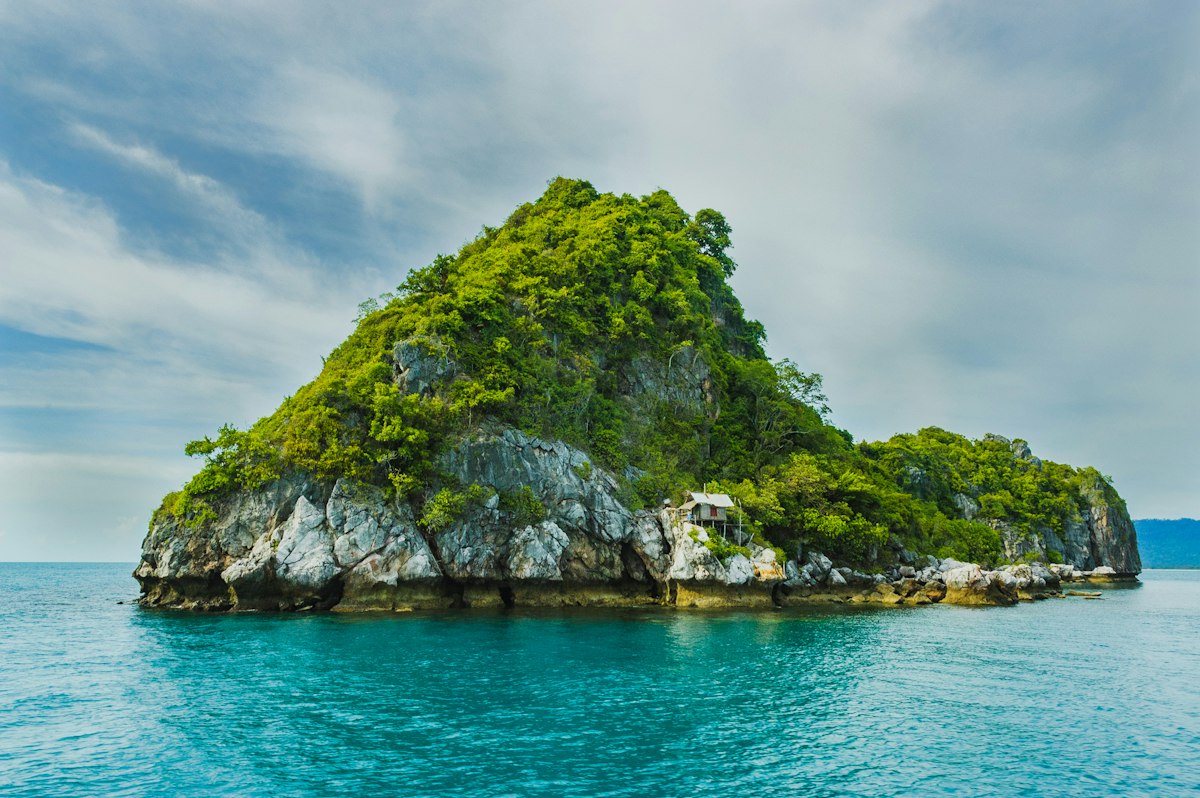
Three nautical miles northwest of Saint Barthélemy's Colombier peninsula, rising from the Caribbean Sea like the spine of a submerged dragon, Île Fourchue presents the most deliberately inhospitable landscape in the Leeward Islands. There is no dock. No beach, in any conventional sense — only volcanic rock shelves that descend into water so clear the seabed is visible at twelve metres. No electricity, no fresh water, no permanent structure. The island's 99 hectares of sun-blasted volcanic terrain support only cactus, low scrub, and the occasional colony of brown pelicans that regard visiting yachts with the indifference of creatures who have never had reason to fear anything. And yet, on any given day during high season, the anchorage between Île Fourchue's twin peaks holds some of the most valuable private vessels in the Caribbean.
The Geology of Exclusion
Île Fourchue — literally "Forked Island," named for the deep cleft that divides its two volcanic peaks — is the largest of the small islands and rocks that constitute Saint Barthélemy's outer archipelago. Its geological character is radically different from the main island: where Saint-Barth's hills are softened by tropical vegetation and punctuated by white sand beaches, Île Fourchue is raw volcanic geology — exposed rhyolite and andesite formations, weathered into shapes that suggest a landscape from the early Cretaceous rather than the contemporary Caribbean.
This geological severity is the source of Île Fourchue's luxury proposition. The island cannot be developed — its terrain resists all conventional construction, its lack of fresh water makes permanent habitation impractical, and its protected status under the Réserve Naturelle de Saint-Barthélemy prohibits any structural intervention. In a region where every accessible beach has been claimed by a resort, every harbour by a marina, and every hilltop by a villa, Île Fourchue's resistance to human imposition has become the rarest amenity in the Caribbean: inviolable emptiness.
The Anchorage: Caribbean's Last Unmediated Experience
The anchorage at Île Fourchue occupies the sheltered bay between the island's two peaks, where the volcanic ridge breaks to create a natural harbour with a sand bottom at six to ten metres — ideal holding ground for the anchor chains of vessels ranging from 15-metre sailing yachts to 60-metre motor yachts. The protection from the Atlantic swell is excellent on the western side; the water clarity is astonishing, with visibility regularly exceeding twenty metres in conditions that make snorkelling feel like flying over an underwater volcanic landscape.
The experience of anchoring at Île Fourchue is irreducible. There is no restaurant ashore to visit, no boutique, no bar, no Wi-Fi signal, no sound except wind and wave and the occasional territorial complaint of a pelican. Everything that constitutes the experience must come from the vessel itself — the provisions, the entertainment, the comfort. This radical self-sufficiency is precisely the point. At Île Fourchue, the yacht ceases to be a vehicle and becomes the destination — a private island in its own right, positioned within a landscape that suggests the world before human habitation.
The Day Charter Economy
Île Fourchue has become the default destination for Saint-Barth's most premium day charter experiences. The island's proximity to Gustavia — thirty minutes by high-performance tender, forty-five minutes by sailing catamaran — makes it the ideal endpoint for a full-day excursion that combines open-water sailing, volcanic-coast snorkelling, and an anchored lunch prepared by the charter crew using provisions sourced from Saint-Barth's exceptional foodscape.
A private day charter to Île Fourchue for eight guests, aboard a 20-metre catamaran with a professional skipper and onboard chef, begins at approximately €3,500 — a cost that, divided among a group, represents extraordinary value for an experience that is genuinely unrepeatable. No two days at Île Fourchue are identical: the light shifts with the season, the marine life varies with currents and temperature, the wind determines which side of the island offers optimal shelter. This variability — this surrender to natural conditions rather than engineered consistency — is the opposite of the resort experience, and for a certain kind of traveller, infinitely more satisfying.
The Marine Sanctuary
The waters surrounding Île Fourchue were designated a marine protected area in 1996, and the three decades of protection have produced an underwater ecosystem of remarkable richness. The volcanic rock formations create habitats for hawksbill turtles, spotted eagle rays, and reef shark species that have been displaced from more heavily trafficked waters. The coral growth on the submerged volcanic shelves — brain corals, elkhorn formations, and delicate fan corals that sway in the current like slow-motion flags — represents some of the healthiest reef ecology in the northern Caribbean.
For the snorkeller or free-diver, Île Fourchue offers an experience that most Caribbean destinations have long since lost to overuse and climate stress. The absence of boat traffic (anchoring is restricted to the main bay), the absence of coastal runoff (there is no development to produce it), and the depth of the surrounding waters (the volcanic shelf drops to sixty metres within two hundred metres of shore) create conditions of exceptional clarity and marine biodiversity. Swimming along Île Fourchue's submerged volcanic walls, surrounded by schooling jacks and the occasional passing barracuda, is the closest approximation to diving a pristine volcanic seamount that the Caribbean offers without a liveaboard expedition.
The Philosophy of Nothing
Île Fourchue's ultimate luxury is its refusal to provide anything. In a market saturated with amenities — where luxury is measured in thread count, butler ratios, and the breadth of pillow menus — the island offers only geology, water, light, and wind. There is nothing to buy, nothing to consume, nothing to photograph for social media that would communicate anything beyond "I was somewhere empty and it was extraordinary."
This negation is, paradoxically, Île Fourchue's most valuable asset. The island functions as a mirror: stripped of all commercial mediation, visitors encounter only themselves, their companions, and the elemental forces that shaped these volcanic rocks long before human beings arrived in the Caribbean. For Saint-Barth's most sophisticated visitors — those who have exhausted the pleasures of Nikki Beach and the boutiques of Gustavia and the villa terraces overlooking Gouverneur — Île Fourchue represents the final luxury: the discovery that the most profound experience available on this island is the one that requires leaving it entirely, crossing three miles of open water to a place where there is nothing at all except everything that matters.