Anse des Cayes: How Saint Barthélemy's Most Dramatically Surf-Swept Shore Became the Island's Most Athletically Refined Luxury Address
March 30, 2026 · 15 min read
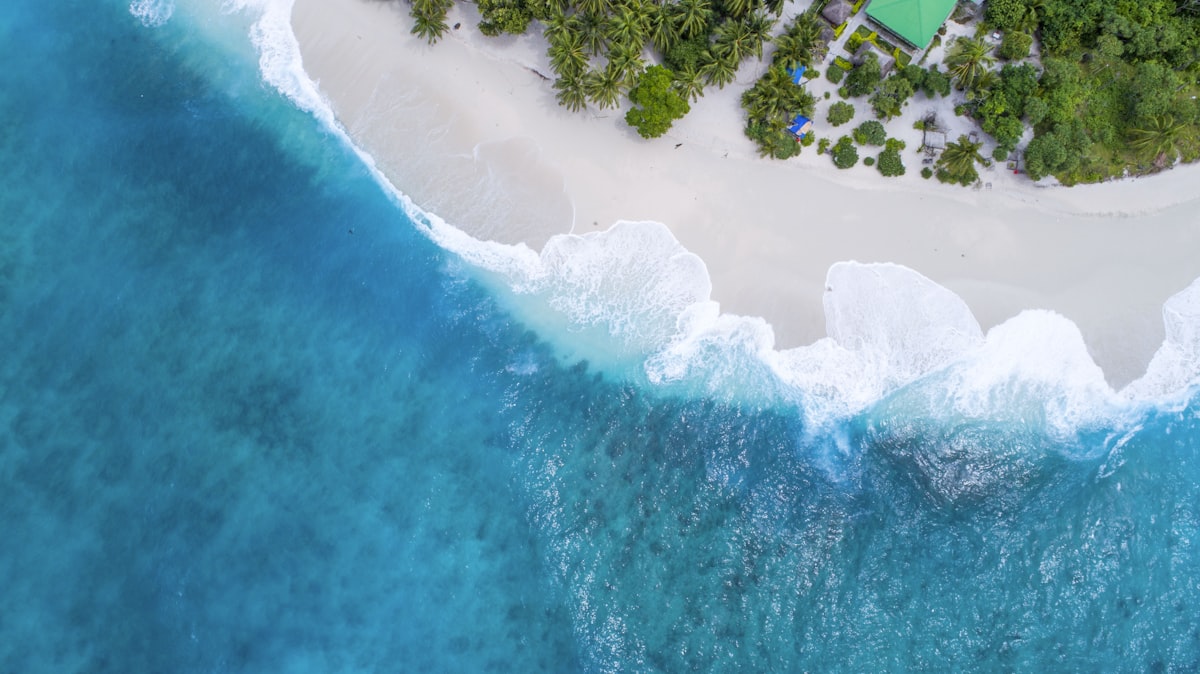
Saint Barthélemy's luxury mythology is constructed almost entirely around calm water: the crystalline leeward coves of Gouverneur and Colombier, the sheltered anchorage of Gustavia harbour, the reef-protected shallows of Saint-Jean where superyacht tenders glide to shore with champagne-cooler precision. Anse des Cayes operates on the opposite principle. This is the island's Atlantic face — the north-shore bay where open-ocean swells generated by weather systems thousands of miles away arrive unimpeded, breaking over a reef system that produces the most consistent and powerful surf in the Lesser Antilles. It is a landscape defined by energy rather than tranquility, and it has attracted a cohort of luxury buyers for whom the ocean's force is not a hazard to be engineered away but a spectacle to be inhabited.
The Physics of the North Shore
The Caribbean's reputation as a surfing destination has historically been modest, and deliberately so. The island chain's leeward coasts — the faces that tourism marketing presents to the world — are sheltered by their own geography, producing the flat, turquoise conditions that populate travel brochures. But the windward and northern exposures tell a different story. Anse des Cayes faces almost directly north, receiving the full force of North Atlantic swells that have been building across thousands of kilometres of open ocean. The bay's bathymetry — a gradual shelf that rises abruptly at the reef line — creates a wave that is both powerful and remarkably consistent, breaking between November and May with a regularity that rivals far more celebrated surf destinations.
The wave at Anse des Cayes is not for beginners. On a solid north swell — six to ten feet, with fifteen-second periods — the break produces a fast, hollow right-hander that barrels across the reef with Caribbean-blue clarity. The water's transparency adds a dimension absent from the murky lineups of most Atlantic surf breaks: you can see the reef below as the wave pitches, the marine life scattering in the whitewater, the volcanic rock shelf that gives the break its shape and its danger. Local surfers — a tight community of fewer than thirty regular riders — have developed a wave knowledge that is transmitted informally, almost secretively, in a culture that values scarcity of information as much as quality of wave.
The Architectural Response to Force
Building on Anse des Cayes' oceanfront presents engineering challenges that are fundamentally different from — and considerably more demanding than — those of Saint Barth's sheltered bays. The properties that line the bay's eastern headland and elevated ridge must contend with salt spray exposure that is two to three times greater than leeward sites, wind loads that peak at 250 kilometres per hour during hurricane season, and a sonic environment dominated by the constant percussion of breaking waves. These conditions have produced architecture that is simultaneously rugged and refined — structures that acknowledge the ocean's power rather than pretending it doesn't exist.
The signature Anse des Cayes villa is oriented toward the wave. Floor-to-ceiling glass panels — hurricane-rated laminated systems capable of withstanding Category 5 impacts — frame the surf break as a living canvas. Infinity pools are positioned not for sunset contemplation but for dawn surf checks, their edges aligned with the horizon so that the transition from pool surface to ocean surface to breaking wave creates a continuous visual field. Outdoor terraces are engineered with drainage systems designed for wave-splash events during major swells, when the ocean's reach extends far beyond its normal boundary. Materials favour raw concrete, weathered teak, and volcanic stone — surfaces that age with salt and wind rather than degrading under them.
The Culture of Athletic Luxury
Anse des Cayes has become the gravitational centre of a lifestyle proposition that distinguishes itself sharply from Saint Barth's dominant identity as a site of indulgent leisure. The bay's homeowners and long-term renters are disproportionately drawn from the demographic that luxury market analysts increasingly identify as the "active ultra-high-net-worth" cohort: individuals whose wealth was generated through entrepreneurship rather than inheritance, whose daily routines include physical training as a non-negotiable discipline, and whose relationship with nature is participatory rather than observational. These are buyers who want to surf before breakfast, kitesurf before lunch, and freedive the reef in the afternoon — and who expect their property to function as a base camp for these activities rather than merely as a stage for evening entertainment.
The supporting infrastructure has evolved accordingly. The bay's eastern end hosts a small but exceptional board-shaping operation, where custom surfboards are built from sustainably sourced paulownia wood and hand-glassed with bio-resin — objects whose price points (€3,000–€8,000) and craftsmanship align with the luxury positioning of the neighbourhood. A freediving instructor, formerly based in Dahab and lured to Saint Barth by a private client, offers coaching from the bay's deeper eastern reef, where visibility routinely exceeds 30 metres and depth drops to 25 metres within swimming distance of shore. The convergence of these elements — world-class surf, pristine freediving, artisanal equipment culture — has created a micro-destination within the island that appeals to precisely the demographic that conventional luxury hospitality has struggled to reach.
The Market Recalibration
For the better part of two decades, Anse des Cayes' property values trailed those of Gouverneur, Flamands, and Colombier by margins of 30–50%. The north shore's rougher conditions, its distance from Gustavia, and the absence of the calm swimming that defines the Caribbean vacation archetype kept it firmly in the second tier of Saint Barth's real estate hierarchy. The recalibration began around 2019, when three factors converged: the post-Hurricane Irma rebuild, which demonstrated that properly engineered north-shore construction could withstand the worst the Atlantic could deliver; the global pandemic, which catalysed demand for properties offering direct access to outdoor athletic activity; and a generational shift in the ultra-luxury buyer profile toward younger, more active, more experience-oriented clients.
Transaction prices have responded. Oceanfront properties at Anse des Cayes that traded for €5–€7 million in 2018 now command €10–€15 million, with the most exceptional compounds — those offering direct cliff-edge positioning above the surf break — achieving per-square-metre prices that rival Gouverneur. The rental market has been equally responsive: a well-positioned Anse des Cayes villa now generates €80,000–€150,000 per week during the December–April season, driven by clients who specifically seek the north shore's conditions. The price convergence suggests that the market has begun to recognise what Anse des Cayes' earliest devotees always understood: that the most compelling luxury on an island defined by water is not the absence of waves but the presence of extraordinary ones.
The Sound and the Fury
There is a quality to Anse des Cayes that no photograph can capture and no description fully conveys: the sound. The constant, rhythmic detonation of Atlantic swells on volcanic reef creates a bass-frequency backdrop that penetrates every room of every property within 200 metres of the shore. It is not the gentle lapping of leeward water but a deep, structural vibration — felt as much as heard — that operates on the body's nervous system like a natural metronome. Residents describe sleeping better at Anse des Cayes than anywhere else on the island, a phenomenon that sleep researchers attribute to the low-frequency white noise generated by consistent surf: a sound pattern so regular that the brain ceases to process it consciously while continuing to receive its calming frequency.
This sonic landscape is, ultimately, Anse des Cayes' most irreducible luxury. It cannot be manufactured, relocated, or replicated. It exists because of a specific conjunction of ocean bathymetry, prevailing swell direction, reef geometry, and geographic exposure that produces, on this particular stretch of Saint Barthélemy's north shore, a sound that is unique on the planet. To live within it is to inhabit a frequency — constant, powerful, ancient — that reconnects the human body to the oceanic rhythms from which all terrestrial life originally emerged. In a luxury market increasingly saturated with the artificial and the curated, Anse des Cayes offers something startlingly elemental: the unmediated voice of the Atlantic, delivered through volcanic rock, at the doorstep of the most exclusive island in the Western Hemisphere.
Saint Barth Latitudes
Premium intelligence on Saint Barthélemy luxury real estate, lifestyle, and island living.
Request Access →